13. Volume
Homework
-
The base of a solid is the area between the semicircle \(y=\sqrt{9-x^2}\) and the \(x\)-axis. Find its volume if the cross-sections perpendicular to the \(x\)-axis are squares.
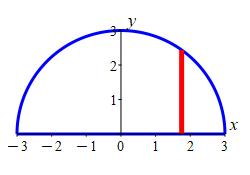
-
The base of a solid is the region between \(x=2y^2\) and \(x=8y\). The cross-sections perpendicular to the \(y\)-axis are semicircles. Find the volume.
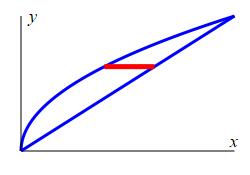
-
In each problem, the planar region bounded by the given curves is rotated about the indicated line to sweep out a volume. Will you do an \(x\)-integral or a \(y\)-integral? Are the Riemann sum rectangles horizontal or vertical? When the rectangle is rotated, does it sweep out a thin disk, thin washer or thin cylinder?
-
Between \(y=x^2\) and \(y=8-x^2\) about the \(x\)-axis.
-
Between \(x=y^3\) and the \(y\)-axis, between \(y=1\) and \(y=3\) about the \(y\)-axis.
-
Between \(x=y^2+2\) and \(x=6\) for \(y \ge 0\) about the \(x\)-axis.
-
Between \(x=y^2+2\) and \(x=6\) for \(y \ge 0\) about the line \(y=-2\).
-
Between \(y=x^2\) and \(y=4\) about the line \(x=2\).
-
Between \(y=x^2\) and \(y=4\) about the line \(y=8\).
-
Between \(y=\sqrt{x}\) and the \(x\)-axis, between \(x=0\) and \(x=4\) about the \(y\)-axis.
-
Between \(y=\sqrt{x}\) and the \(x\)-axis, between \(x=0\) and \(x=4\) about the \(x\)-axis.
-
Between \(x=y^2+2\) and \(x=6\) for \(y \ge 0\) about the \(y\)-axis.
-
Between \(x=y^2+2\) and \(x=6\) for \(y \ge 0\) about the line \(x=8\).
-
Between \(x=5-y^2\) and the line \(x=1\) about the line \(x=1\).
-
Between \(y=x^2\) and \(y=4\) about the line \(y=4\).
-
-
The area between \(y=\sqrt{x}\) and the \(x\)-axis for \(0 \le x \le 4\) is rotated about the \(x\)-axis. Find the volume swept out.
-
The area between \(y=\sqrt{x}\) and the \(x\)-axis for \(0 \le x \le 4\) is rotated about the \(y\)-axis. Find the volume swept out.
-
The area between \(y=\sqrt{x}\) and \(y=x\) is rotated about the \(x\)-axis. Find the volume swept out.
-
The area between \(y=\sqrt{x}\) and \(y=x\) is rotated about the \(y\)-axis. Find the volume swept out.
-
The area between \(x=y^2+2\) and \(x=6\) for \(y \ge 0\) is rotated about the \(x\)-axis. Find the volume swept out.
-
The area between \(x=y^2+2\) and \(x=6\) for \(y \ge 0\) is rotated about the line \(x=8\). Find the volume swept out.
-
The area between \(y=e^x\) and the \(x\)-axis for \(0 \le x \le 1\) is rotated about the line \(y=-1\). Find the volume swept out.
-
The area between \(y=e^x\) and the \(x\)-axis for \(0 \le x \le 1\) is rotated about the \(y\)-axis. Find the volume swept out.
Heading
Placeholder text: Lorem ipsum Lorem ipsum Lorem ipsum Lorem ipsum Lorem ipsum Lorem ipsum Lorem ipsum Lorem ipsum Lorem ipsum Lorem ipsum Lorem ipsum Lorem ipsum Lorem ipsum Lorem ipsum Lorem ipsum Lorem ipsum Lorem ipsum Lorem ipsum Lorem ipsum Lorem ipsum Lorem ipsum Lorem ipsum Lorem ipsum Lorem ipsum Lorem ipsum