15. Polar Coordinates
d.1. Area Enclosed by a Polar Graph
We have seen how to plot a polar curve. Since any polar curve is periodic, it usually encloses a region. We now want to compute the area of such a region.
Find the area bounded by the graph of \(r=f(\theta)\) and the rays \(\theta=\alpha\) and \(\theta=\beta\). Assume \(f(\theta) \ge 0\).
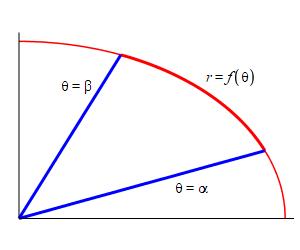
Recall that in rectangular coordinates, to find the area under a curve \(y=f(x)\), we divided the \(x\)-interval into subintervals and approximated the area as the sum of a rectangle over each subinterval. Similarly, to find the area enclosed by a polar curve \(r=f(\theta)\), we divide the \(\theta\)-interval into subintervals and approximate the area as the sum of a circular pie wedge for each subinterval.
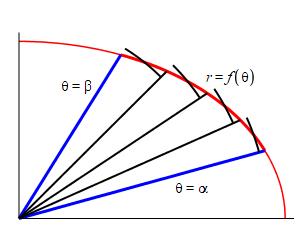
If we divide the \(\theta\)-interval into \(n\) intervals, then the angular width of each wedge is \(\Delta\theta=\dfrac{\beta-\alpha}{n}\) and the radius of the \(i^\text{th}\) wedge is \(r_i=f\left(\theta_i^*\right)\) for some angle \(\theta_i^*\) in the \(i^\text{th}\) interval. Now the area of a pie wedge of angle \(\Delta\theta\) (in radians) and radius \(r_i\) is \[ \Delta A =\left(\dfrac{\Delta\theta}{2\pi}\right)\pi r_i^2 =\dfrac{1}{2}r_i^2\,\Delta\theta \] So the total area is obtained by adding up the areas of the wedges and taking the limit as the number of wedges becomes large, (\(n\to\infty\)): \[ A =\lim_{n\to\infty} \sum_{i=1}^n \dfrac{1}{2}r_i^2\,\Delta\theta =\lim_{n\to\infty} \sum_{i=1}^n \dfrac{1}{2}f\left(\theta_i^*\right)^2\,\Delta\theta \] This limit of a sum is recognized as the integral: \(\displaystyle A=\int_\alpha^\beta \dfrac{1}{2}f(\theta)^2\,d\theta\).
The area bounded by the graph of \(r=f(\theta)\) and the rays \(\theta=\alpha\) and \(\theta=\beta\) is: \[ A=\int_\alpha^\beta \dfrac{1}{2}f(\theta)^2\,d\theta \] We often remove the reference to \(f\) and write this formula as \[ A=\int_\alpha^\beta \dfrac{1}{2}r^2\,d\theta \]
Find the area of the upper half of the cardioid, \(r=1+\cos\theta\).
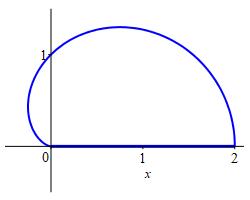
It is clear that the upper half of the cardioid is swept out as \(\theta\) increases from \(0\) to \(\pi\). Thus the area is: \[\begin{aligned} A&=\int_0^\pi \dfrac{1}{2}(1+\cos\theta)^2\,d\theta \\ &=\dfrac{1}{2}\int_0^\pi (1+2\cos\theta+\cos^2\theta)\,d\theta \\ &=\dfrac{1}{2}\int_0^\pi \left(1+2\cos\theta+\dfrac{1+\cos(2\theta)}{2}\right)\,d\theta \\ &=\dfrac{1}{2}\left[\theta+2\sin\theta+\dfrac{\theta}{2}+\dfrac{\sin(2\theta)}{4}\right]_0^\pi =\dfrac{3\pi}{4} \end{aligned}\]
Find the area bounded by one petal of the 3-leaf rose \(r=\cos(3\theta)\).
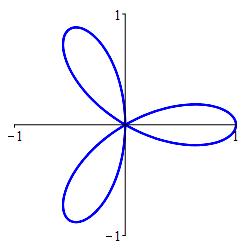
The most difficult part of the problem is determining the limits of integration. However, these occur at the angles where the curve passes through the origin. So solve \(r=\cos(3\theta)=0\) and select two adjacent solutions.
\(A=\dfrac{\pi}{12}\)
The solutions of \(r=\cos(3\theta)=0\) occur when \[ 3\theta=\pm\dfrac{\pi}{2},\pm\dfrac{3\pi}{2},\pm\dfrac{5\pi}{2},\ldots \] or \[ \theta=\pm\dfrac{\pi}{6},\pm\dfrac{3\pi}{6},\pm\dfrac{5\pi}{6},\ldots \] The petal on the right occurs for \(-\,\dfrac{\pi}{6} \le \theta \le \dfrac{\pi }{6}\). Thus the area is: \[\begin{aligned} A&=\dfrac{1}{2}\int_{-\pi/6}^{\pi/6} \cos^2(3\theta)\,d\theta \\ &=\dfrac{1}{2}\int_{-\pi/6}^{\pi/6} \dfrac{1+\cos(6\theta)}{2}\,d\theta \\ &=\dfrac{1}{4}\left[\theta+\dfrac{\sin(6\theta)}{6}\right]_{-\pi/6}^{\pi/6} =\dfrac{\pi }{12} \end{aligned}\]
Heading
Placeholder text: Lorem ipsum Lorem ipsum Lorem ipsum Lorem ipsum Lorem ipsum Lorem ipsum Lorem ipsum Lorem ipsum Lorem ipsum Lorem ipsum Lorem ipsum Lorem ipsum Lorem ipsum Lorem ipsum Lorem ipsum Lorem ipsum Lorem ipsum Lorem ipsum Lorem ipsum Lorem ipsum Lorem ipsum Lorem ipsum Lorem ipsum Lorem ipsum Lorem ipsum