15. Polar Coordinates
d. Area Enclosed by a Polar Graph
2. Area Between Polar Graphs
So far, we have seen how to compute the area between a polar curve and the origin. We now look at computing the area between two polar curves.
Find the area bounded by the graphs of \(r=f(\theta)\) and \(r=g(\theta)\) between the rays \(\theta=\alpha\) and \(\theta=\beta\). Assume \(f(\theta) \ge g(\theta) \ge 0\).
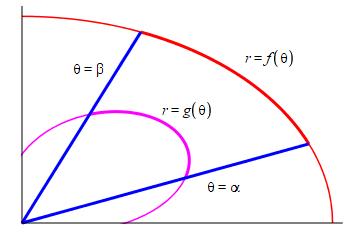
The area enclosed by \(r=f(\theta)\) is \(\displaystyle A=\int_\alpha^\beta \dfrac{1}{2}f(\theta)^2\,d\theta\), while the area enclosed by \(r=g(\theta)\) is \(\displaystyle A=\int_\alpha^\beta \dfrac{1}{2}g(\theta)^2\,d\theta\). We simply subtract to obtain:
The area bounded by the graphs of \(r=f(\theta)\) and \(r=g(x)\) between the rays \(\theta=\alpha\) and \(\theta=\beta\) is \[ A=\int_\alpha^\beta \dfrac{1}{2}[f(\theta)^2-g(\theta)^2]\,d\theta \] provided \(f(\theta) \ge g(\theta) \ge 0\).
Find the area of the region outside the circle \(r=1\) but inside the cardioid, \(r=2+2\sin\theta\).
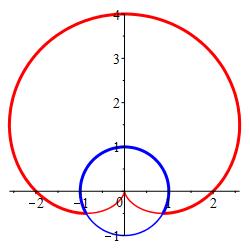
The only difficulty is finding the limits of integration. These are where the two curves intersect. So we equate the functions and solve: \[ 2+2\sin\theta=1 \qquad \Rightarrow \qquad 2\sin\theta=-1 \qquad \Rightarrow \qquad \sin\theta=-\,\dfrac{1}{2} \] The intersection in the \(4^\text{th}\) quadrant is at \(\theta=-\,\dfrac{\pi}{6}\). The intersection in the \(3^\text{rd}\) quadrant is at \(\theta=\dfrac{7\pi}{6}\). So the area is \[\begin{aligned} A &=\dfrac{1}{2}\int_{-\pi/6}^{7\pi/6} [(2+2\sin\theta)^2-1^2]\,d\theta \\ &=\dfrac{1}{2}\int_{-\pi/6}^{7\pi/6} [3+8\sin\theta+4\sin^2]\,d\theta \\ &=\dfrac{1}{2}\int_{-\pi/6}^{7\pi/6} [3+8\sin\theta+2(1-\cos(2\theta))]\,d\theta \\ &=\dfrac{1}{2}\int_{-\pi/6}^{7\pi/6} [5+8\sin\theta-2\cos(2\theta)]\,d\theta \\ &=\dfrac{1}{2}[5\theta-8\cos\theta-\sin(2\theta)]_{-\pi/6}^{7\pi/6} =\dfrac{10\pi}{3}+\dfrac{7\sqrt{3}}{2} \end{aligned}\]
It is important to integrate from \(\theta=-\,\dfrac{\pi}{6}\) to \(\theta=\dfrac{7\pi}{6}\) which covers the area between the curves, including \(\theta=0\), \(\dfrac{\pi}{2}\) and \(\pi\). If one instead integrates from \(\theta=\dfrac{7\pi}{6}\) to \(\theta=\dfrac{11\pi}{6}\), then one gets the area at the bottom inside the circle outside the cardioid.
Caution: It is not always possible to find the points of intersection of two polar graphs by simply equating the functions as was done in the preceeding example. Recall the discussion on Intersections of Polar Graphs.
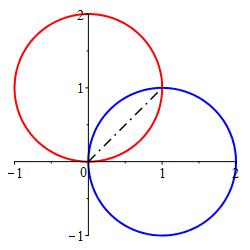
Find the area of the region enclosed by both polar graphs, \(r=2\sin\theta\) and \(r=2\cos\theta\).
The graphs are circles. By symmetry, you can compute half of the area and double it.
\(A=\dfrac{\pi}{2}-1\)
The graphs are circles. In a previous exercise, we found the graphs intersect at \((r,\theta)=\left(\sqrt{2},\dfrac{\pi}{4}\right)\) and at the origin. By symmetry, we split the region in half (as shown) and double the area. The bottom half is bounded by the ray at \(\theta=\dfrac{\pi}{4}\) and the red circle \(r=2\sin\theta\) which comes into the origin at \(\theta=0\). So the area is:
\[\begin{aligned} A&=2\int_0^{\pi/4} \dfrac{1}{2}r(\theta)^2\,d\theta =2\int_0^{\pi/4} \dfrac{1}{2}(2\sin\theta)^2\,d\theta \\ &=4\int_0^{\pi/4} \sin^2\theta\,d\theta =2\int_0^{\pi/4} (1-\cos(2\theta))\,d\theta \\ &=2\left[\theta-\,\dfrac{\sin(2\theta)}{2}\right]_0^{\pi/4} =\dfrac{\pi}{2}-1 \end{aligned}\]
Heading
Placeholder text: Lorem ipsum Lorem ipsum Lorem ipsum Lorem ipsum Lorem ipsum Lorem ipsum Lorem ipsum Lorem ipsum Lorem ipsum Lorem ipsum Lorem ipsum Lorem ipsum Lorem ipsum Lorem ipsum Lorem ipsum Lorem ipsum Lorem ipsum Lorem ipsum Lorem ipsum Lorem ipsum Lorem ipsum Lorem ipsum Lorem ipsum Lorem ipsum Lorem ipsum