10. Area and Average Value
d. Average Value and Mean Value Theorem
1. Average Value of a Function
Recall that to find the average of \(n\) numbers, \(f_1,f_2,\ldots,f_n\) we add the numbers and divide by \(n\): \[ f_\text{ave}=\dfrac{f_1+f_2+\cdots+f_n}{n} \]
Approximate the average value of a function \(f(x)\) on an interval \([a,b]\).
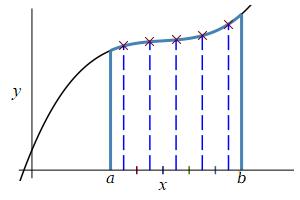
We first divide the interval into \(n\) subintervals each of width \(\Delta x=\dfrac{b-a}{n}\) and sample the function at a point \(x_i^*\) in the \(i^\text{th}\) interval giving the \(n\) numbers \(f(x_1^*),f(x_2^*),\ldots,f(x_n^*)\). The average of the function \(f(x)\) can be approximated by the average of these numbers: \[\begin{aligned} f_\text{ave} &\approx\dfrac{f(x_1^*)+f(x_2^*)+\cdots+f(x_n^*)}{n} \\ &\quad=\dfrac{1}{n}\sum_{i=1}^n\,f(x_i^*) \end{aligned}\]
Approximate the average of the function \(f(x)=x^2\) on \([1,4]\) by dividing the interval into \(3\) subintervals and evaluating \(f(x)\) at the \(3\) midpoints.
\(\displaystyle f_\text{ave}\approx6.917\)
We can approximate the average of the function \(f(x)=x^2\) on \([1,4]\) by dividing the interval into \(3\) subintervals and evaluating \(f(x)\) at the \(3\) midpoints: \[\begin{aligned} f(1.5)&=1.5^2=2.25 \\ f(2.5)&=2.5^2=6.25 \\ f(3.5)&=3.5^2=12.25 \end{aligned}\] and averaging to get \[ f_\text{ave}\approx\dfrac{2.25+6.25+12.25}{3}=6.917 \]
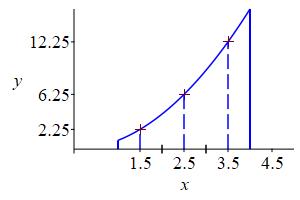
You will see in the next example that the correct average is \(f_\text{ave}=7\).
Find the average value of a function \(f(x)\) on an interval \([a,b]\).
If we sample \(n\) points in the interval, then the average of the function \(f(x)\) is approximately: \[ f_\text{ave} \approx\dfrac{1}{n}\sum_{i=1}^n\,f(x_i^*) \] To get the exact average, we take the limit as \(n\rightarrow\infty\): \[ f_\text{ave} =\lim_{n\rightarrow\infty}\dfrac{1}{n} \sum_{i=1}^n f(x_i^*) \] This looks almost like the definition of an integral, except there is a \(\dfrac{1}{n}\) instead of a \(\Delta x\). To fix that, we multiply and divide by \(b-a\) and recall that \(\dfrac{b-a}{n}=\Delta x\): \[\begin{aligned} f_\text{ave} &=\dfrac{1}{b-a}\lim_{n\rightarrow\infty}\dfrac{b-a}{n} \sum_{i=1}^n f(x_i^*) \\ &=\dfrac{1}{b-a}\lim_{n\rightarrow\infty} \sum_{i=1}^n f(x_i^*)\Delta x \end{aligned}\] This is the Riemann sum for an integral. Thus we conclude:
The average value of a function \(f(x)\) on an interval \([a,b]\) is: \[ f_\text{ave}=\dfrac{1}{b-a}\int_a^b f(x)\,dx \]
Find the average value of the function \(y=x^2\) on the interval \([1,4]\).
\(\displaystyle f_\text{ave}=\dfrac{1}{3}\int_1^4 x^2\,dx=7\)
We have \(a=1\), \(b=4\) and \(f(x)=x^2\). So \[\begin{aligned} f_\text{ave} &=\dfrac{1}{4-1}\int_1^4 x^2\,dx =\dfrac{1}{3}\left[\dfrac{x^3}{3}\right]_1^4 \\ &=\dfrac{1}{3}\left[\dfrac{64}{3}-\dfrac{1}{3}\right] =\dfrac{63}{9}=7 \end{aligned}\] The approximation \(6.917\) was very close to this.
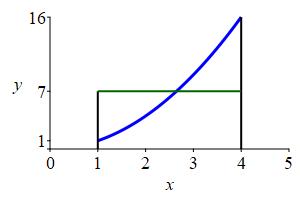
Try another one:
Find the average value of the function \(y=(x-2)^2\) on the interval \([1,3]\).
^2_prob.jpg)
\(\displaystyle f_\text{ave}=\dfrac{1}{2}\int_1^3 (x-2)^2\,dx=\dfrac{1}{3}\)
We have \(a=1\), \(b=3\) and \(f(x)=(x-2)^2\). So \[\begin{aligned} f_\text{ave} &=\dfrac{1}{3-1}\int_1^3 (x-2)^2\,dx =\dfrac{1}{2}\left[\dfrac{(x-2)^3}{3}\right]_1^3 \\ &=\dfrac{1}{6}[1]-\dfrac{1}{6}[-1] =\dfrac{2}{6}=\dfrac{1}{3} \end{aligned}\]
^2_sol.jpg)
On the next page, we will see a geometric interpretation of the average value in terms of area.
Heading
Placeholder text: Lorem ipsum Lorem ipsum Lorem ipsum Lorem ipsum Lorem ipsum Lorem ipsum Lorem ipsum Lorem ipsum Lorem ipsum Lorem ipsum Lorem ipsum Lorem ipsum Lorem ipsum Lorem ipsum Lorem ipsum Lorem ipsum Lorem ipsum Lorem ipsum Lorem ipsum Lorem ipsum Lorem ipsum Lorem ipsum Lorem ipsum Lorem ipsum Lorem ipsum