23. Riemann Sums, Integrals and the FTC
Homework
-
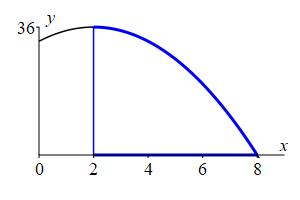
Approximate the area below \(\displaystyle y=36-(x-2)^2\) above the interval \([2,8]\) using a Riemann sum with \(3\) equal width intervals and:
-
left endpoints.
Is this an underestimate or overestimate and why?
Your reason should depend on increasing, decreasing, concave up or concave down. -
right endpoints.
Is this an underestimate or overestimate and why?
Your reason should depend on increasing, decreasing, concave up or concave down. -
midpoints.
-
Now compute the area using the Fundamental Theorem of Calculus.
Were your predictions of overestimate or underestimate correct? -
(Honors Only) Recompute the area using a limit of Riemann Sums.
-
-
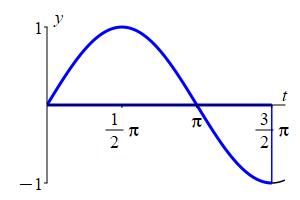
Approximate the integral \(\displaystyle \int_{0}^{3\pi/2} \sin\theta\,d\theta\) using a Riemann sum with \(3\) equal width intervals and:
-
left endpoints.
-
right endpoints.
-
midpoints.
-
Now compute the integral using the FTC.
-
-
Compute \(\displaystyle \int_0^6 f(x)\,dx\) for the piecewise defined function: \[ f(x)= \begin{cases} \sqrt{4-(x-2)^2} & \text{if } 0 \le x \le 2\\ 2 & \text{if } 2 \lt x \le 4 \\ \sqrt{4-(x-4)^2} & \text{if } 4 \lt x \le 6 \end{cases} \] HINT: Graph the function.
NOTE: If you use Desmos (or equivalent), remember you won't have Desmos on the exam! -
\(\displaystyle \int_1^3 (3x^5-3x^2)\,dx\)
-
\(\displaystyle \int_{\ln 2}^{\ln 4} 4e^{2x}\,dx\) Simplify!
-
\(\displaystyle \int_{\small e^2}^{\small e^4} \dfrac{6}{x}\,dx\) Simplify!
-
\(\displaystyle \int_{1/2}^{1} \dfrac{2}{\sqrt{1-x^2}}\,dx\) Simplify!
-
\(\displaystyle \int_{-1}^1 2xe^{2x}+x^22e^{2x}\,dx\)
-
Compute \(\displaystyle \dfrac{d}{dx}\int_3^x \dfrac{3}{3+t^3}\,dt\).
-
Compute \(\displaystyle \dfrac{d}{dx}\int_x^3 \dfrac{3}{3+t^3}\,dt\).
-
Compute \(\displaystyle \dfrac{d}{dx}\int_{3x}^{x^3} \dfrac{3}{3+t^3}\,dt\).
-
Which is larger, \(\displaystyle \int_0^{\pi/4} \sin^2(x)\, dx\) or \(\displaystyle \int_0^{\pi/4} \cos^2(x)\, dx\), and why?
-
Find upper and lower bounds for \(\displaystyle \int_0^{\pi/4} \cos^2(x)\, dx\) using the minimum and maximum values of \(\cos^2(x)\) on the interval \(\left[0,\dfrac{\pi}{4}\right]\).
-
Find the area below \(y=|x^2-4|\) above the \(x\)-axis between \(x=0\) and \(x=4\).
Use the \(2^\text{nd}\) Fundamental Theorem of Calculus to compute each of the following integrals.
Use the \(1^\text{st}\) Fundamental Theorem of Calculus or Leibniz's Method to compute each of the following derivatives.
Heading
Placeholder text: Lorem ipsum Lorem ipsum Lorem ipsum Lorem ipsum Lorem ipsum Lorem ipsum Lorem ipsum Lorem ipsum Lorem ipsum Lorem ipsum Lorem ipsum Lorem ipsum Lorem ipsum Lorem ipsum Lorem ipsum Lorem ipsum Lorem ipsum Lorem ipsum Lorem ipsum Lorem ipsum Lorem ipsum Lorem ipsum Lorem ipsum Lorem ipsum Lorem ipsum