16. Max-Min Problems

Homework

  1. Consider the function \(f(x,y)=x^3-xy-x+y^2\). Find all critical points. Then use the Second Derivative Test to classify each as a local minimum, local maximum or saddle or say the test fails.

    We compute the partial derivatives and set them equal to \(0\): \[\begin{aligned} f_x&=3x^2-y-1=0 \\ f_y&=-x+2y=0 \end{aligned}\] We solve for \(x\) and \(y\): Since \(x=2y\), we have \(12y^2-y-1=0\). We use the quadratic formula: \[ y=\dfrac{1\pm\sqrt{1+48}}{24}=\dfrac{1\pm7}{24}=\dfrac{1}{3},\dfrac{-1}{4} \] If \(y=\dfrac{1}{3}\) then \(x=\dfrac{2}{3}\). If \(y=\dfrac{-1}{4}\) then \(x=\dfrac{-1}{2}\).
    The second derivatives and the discriminant are: \[ f_{xx}=6x, \quad f_{yy}=2, \quad f_{xy}=-1, \quad D=f_{xx}f_{yy}-{f_{xy}}^2=12x-1 \] At \((x,y)=\left(\dfrac{2}{3},\dfrac{1}{3}\right)\): \[ f_{xx}=4, \quad D=7, \qquad \text{which is a local minimum.} \] At \((x,y)=\left(\dfrac{-1}{2},\dfrac{-1}{4}\right)\): \[ f_{xx}=-3, \quad D=-7, \qquad \text{which is a saddle point.} \]

  2. Find the radius, height and volume of the largest cylinder with base on the \(xy\) plane and upper circle on the cone \(z=3-\sqrt{x^2+y^2}\).
    Work in cylindrical coordinates.
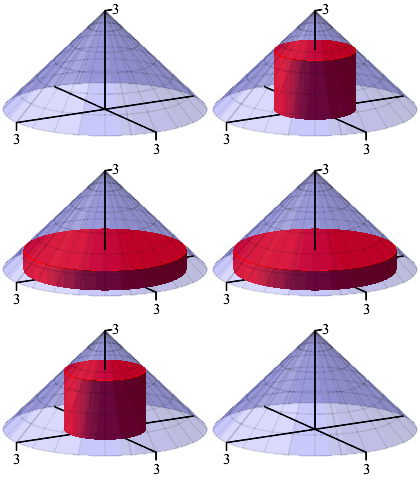
    The figure shows a cone with vertex at z = 3 on the z axis and base
      on the circle of radius 1 in the xy plane. Inside the cone there is a
      cylinder with base in the xy plane and upper edge on the cone. The cone
      is animated so that its radius and height oscillate. When the radius is 1
      and the height is 0, the volume is 0. When the radius is 0
      and the height is 3, the volume is 0. Somewhere in between
      these two extremes is a cylinder with maximal volume.
    1. Solve by eliminating \(z\).

      In cylindrical coordinates, the cone is \(z=3-r\). So the volume of the cylinder is \[ V=\pi r^2h=\pi r^2z=\pi r^2(3-r)=\pi(3r^2-r^3) \] To maximize \(V\), we set the derivative equal to \(0\) and solve for \(r\): \[ V'=\pi(6r-3r^2)=3\pi r(2-r)=0 \quad \implies \quad r=0,2 \] \(r=0\) gives \(V=0\). So the only critical point with non-zero volume is \(r=2\) which must produce the maximum volume. Then \(z=3-r=3-2=1\) and \(V=\pi r^2z=\pi 2^2 1=4\pi\).

    2. Solve by Lagrange multipliers.

      In cylindrical coordinates, the cone is \(z=3-r\). The extremal is the volume of the cylinder: \[ V=\pi r^2h=\pi r^2z \] The constraint is the equation of the cone, written as: \[ g=z+r=3 \] Taking the variables in the order \(r,z\), the gradients are: \[ \vec\nabla V=\langle2\pi rz,\pi r^2\rangle \quad \text{and} \quad \vec\nabla g=\langle1,1\rangle \] The Lagrange equations \(\vec\nabla V=\lambda\vec\nabla g\) are: \[ 2\pi rz=\lambda \quad \text{and} \quad \pi r^2=\lambda \] Eliminating \(\lambda\) gives \(2\pi rz=\pi r^2\). Since \(r\ne0\), this says \(z=\dfrac{r}{2}\). Plugging this into the constraint gives: \[ 3=z+r=\dfrac{r}{2}+r=\dfrac{3}{2}r \] Therefore, \(r=2\), \(z=1\) and \(V=\pi r^2z=4\pi\).

  3. Find the dimensions and volume of the largest rectangular box with base on the \(xy\) plane and upper vertices on the cone \(z=3-\sqrt{x^2+y^2}\).
    Work in rectangular coordinates.
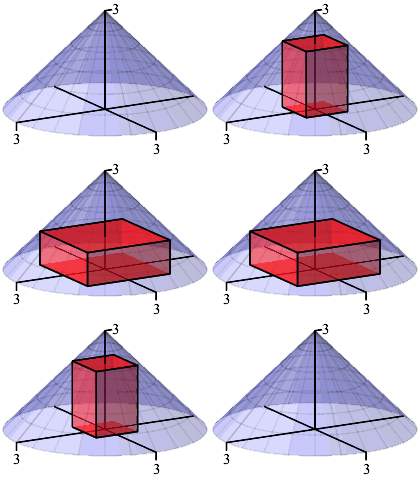
    The figure shows a rectangular box sitting on the xy plane with its
      upper vertices on cone z=3-\sqrt{x^2+y^2}. The box is animated so that
      its length and width oscillate. When the length or width become 0,
      the volume is 0. Somewhere in between these extremes is a rectangular
      box with maximal volume.
    1. Solve by Lagrange multipliers.
      HINT: Rewrite the constraint to eliminate the square root.

      We can rewite the equation of the cone as \(\sqrt{x^2+y^2}=3-z\) or \(x^2+y^2=(z-3)^2\). So we take the constraint as \[ g=x^2+y^2-(z-3)^2=0 \] We take \((x,y)\) in the first quadrant. Then the volume of the box is \[ V=LWH=(2x)(2y)(z)=4xyz \] The gradients are: \[ \vec\nabla V=\langle4yz,4xz,4xy\rangle \quad \text{and} \quad \vec\nabla g=\langle2x,2y,-2(z-3)\rangle \] The Lagrange equations \(\vec\nabla V=\lambda\vec\nabla g\) are: \[ 4yz=\lambda2x \qquad 4xz=\lambda2y \qquad 4xy=-\lambda2(z-3) \] The left sides become the same if we multiply the first by \(x\), the second by \(y\) and the third by \(z\). \[ 4xyz=\lambda2x^2=\lambda2y^2=-\lambda2z(z-3) \] These say: \[ x^2=y^2=-z(z-3) \] Plugging this into the constraint gives: \[\begin{aligned} x^2+y^2-(z-3)^2&=0 \\ -2z(z-3)-(z-3)^2&=0 \\ -(z-3)(2z+z-3)&=0 \\ -3(z-3)(z-1)&=0 \\ \end{aligned}\] So \(z=1\) or \(z=3\). If \(z=3\), then \(x=y=0\) and so \(V=0\). So the only critical point with non-zero volume is \(z=1\) which must produce the maximum volume. Then \(x^2=y^2=2\) and \(x=y=\sqrt{2}\) and \(V=4xyz=4(\sqrt{2})^2(1)=8\).

    2. Solve by eliminating \(z\).
      HINT: What is \(xV_x-yV_y\)?

      We take \((x,y)\) in the first quadrant. Then the volume of the box is \[ V=LWH=(2x)(2y)(z)=4xyz \] We substitute the equation of the cone \(z=3-\sqrt{x^2+y^2}\): \[ V=4xy(3-\sqrt{x^2+y^2})=12xy-4xy\sqrt{x^2+y^2} \] We set the partial derivatives equal to \(0\) and solve: \[\begin{aligned} V_x&=12y-4y\sqrt{x^2+y^2}-\dfrac{4x^2y}{\sqrt{x^2+y^2}}=0 \\ V_y&=12x-4x\sqrt{x^2+y^2}-\dfrac{4xy^2}{\sqrt{x^2+y^2}}=0 \\ \end{aligned}\] We multiply the first equation by \(x\) and the second by \(y\) and subtract: \[ \dfrac{4x^3y-4xy^3}{\sqrt{x^2+y^2}}=0 \] Since \(x \gt 0\) and \(y \gt 0\), this says \(x=y\). Then the \(V_x\) equation reduces to \[\begin{aligned} 12x-4x\sqrt{2x^2}-\dfrac{4x^3}{\sqrt{2x^2}}&=0 \\ 12x-4\sqrt{2}x^2-2\sqrt{2}x^2&=0 \\ 12x-6\sqrt{2}x^2&=0 \\ 2x-\sqrt{2}x^2&=0 \\ \sqrt{2}x(\sqrt{2}-x)&=0 \end{aligned}\] Then \(x=0\) which gives \(V=0\). Or \(x=\sqrt{2}\). Then \(y=\sqrt{2}\) and \(z=3-\sqrt{x^2+y^2}=3-\sqrt{2+2}=1\) and \(V=4xyz=4(\sqrt{2})^2(1)=8\).

  4. Find the point that is closest to the origin on the surface \(z=\dfrac{108}{x^4y^6}\) in the first octant. Then find the distance from the point to the origin.
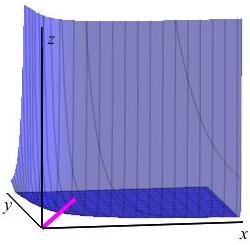
    The graphic shows the surface z = 1 over the quantity x to the
        fourth times y to the sixth in the first octant. It also shows a line
        from the surface to the origin.

    We need to minimize the distance from the origin to the point \((x,y,z)\) on the surface: \[ D=\sqrt{x^2+y^2+z^2} \] It is easier to minimize the square of the distance, which will give the same solution. So we will minimize the function \[ f=D^2=x^2+y^2+z^2 \] We write the surface as the constraint: \[ g=x^4y^6z=108 \] The gradients are: \[ \vec\nabla f=\langle2x,2y,2z\rangle \quad \text{and} \quad \vec\nabla g=\langle 4x^3y^6z,6x^4y^5z,x^4y^6 \rangle \] The Lagrange equations \(\vec\nabla f=\lambda\vec\nabla g\) are: \[ 2x=\lambda 4x^3y^6z \qquad 2y=\lambda 6x^4y^5z \qquad 2z=\lambda x^4y^6 \] The right sides become the same if we multiply the first by \(6x\), the second by \(4y\) and the third by \(24z\): \[ \lambda24x^4y^6z=12x^2=8y^2=24z^2 \] This says \(x^2=2z^2\) and \(y^2=3z^2\). We substitute this into the constraint: \[ 108=x^4y^6z=(x^2)^2(y^2)^3z=(2z^2)^2(3z^2)^3z=108z^{11} \] So \(z=1\) and consequently \(x=\sqrt{2}\) and \(y=\sqrt{3}\). So the closest point is \((x,y,z)=(\sqrt{2},\sqrt{3},1)\). Its distance from the origin is \[ D=\sqrt{2+3+1}=\sqrt{6} \]

  5. A \(118\,\text{cm}\) wire is cut into \(3\) pieces of lengths \(a\), \(b\) and \(c\). The piece of length \(a\) is bent into a square. The piece of length \(b\) is bent into a rectangle whose length is twice its width. The piece of length \(c\) is bent into a rectangle whose length is \(4\) times its width. What are \(a\), \(b\) and \(c\) which minimize the total area enclosed by all \(3\) pieces?
    Solve by using Lagrange Multipliers.
    \(50\%\) off for solving by Eliminating a Variable.
    \(50\%\) Extra Credit for solving both ways. Be sure to clearly separate the calculations.
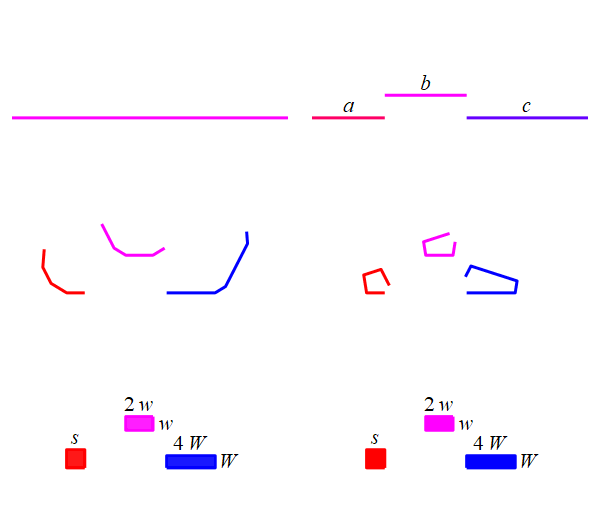
    x_fold_sq_rect_2x1_rect_3x1

    We express the length of the wire as the sum of its parts: \[ L(a,b,c) = a + b +c = 118 \] To minimize the total area of the shapes, we find the area of each shape as a function of the wire segment lengths.
    The piece of length \(a\) is folded into a square of side \(s\): \[\begin{aligned} \text{Perimeter}_{a} &= a = 4s \\ \text{Area}_{a} &= s^2= \dfrac{a^2}{16} \end{aligned}\] The piece of length \(b\) is folded into a rectangle of width \(w\) and length \(2w\): \[\begin{aligned} \text{Perimeter}_{b} &= b = 2w + w + 2w + w = 6w \\ \text{Area}_{b} &= 2w \cdot w = 2w^2= \dfrac{b^2}{18} \end{aligned}\] The piece of length \(c\) is folded into a rectangle of width \(W\) and length \(4W\): \[\begin{aligned} \text{Perimeter}_{c} &= c = 4W + W +4W + W = 10W \\ \text{Area}_{c} &= 4W \cdot W = 4W^2= \dfrac{c^2}{25} \end{aligned}\] The total area is then found by adding the three areas: \[\begin{aligned} A &= \dfrac{a^2}{16} + \dfrac{b^2}{18}+ \dfrac{c^2}{25}\\ \end{aligned}\]


    Lagrange Multipliers: The gradients of the functions are \[ \vec\nabla A=\left(\dfrac{a}{8}, \dfrac{b}{9}, \dfrac{2c}{25}\right) \qquad \vec\nabla L=\left(1,1,1\right) \] The Lagrange equations, \(\vec\nabla A=\lambda\vec\nabla L\), are \[ \dfrac{a}{8}=\lambda \qquad \dfrac{b}{9}=\lambda \qquad \dfrac{2c}{25}=\lambda \] Solving for \(b\) and \(c\) in terms of \(a\) gives: \[\begin{aligned} \dfrac{b}{9}&=\dfrac{a}{8} &\implies b=\dfrac{9a}{8} \\ \dfrac{2c}{25}&=\dfrac{a}{8} &\implies c=\dfrac{25a}{16} \end{aligned}\] Plugging these results into the constraint \(L=118\) gives: \[\begin{aligned} a + \dfrac{9a}{8} + \dfrac{25a}{16} &= 118 \\ 16a+18a+25a&= 16\cdot 118 \\ 59a&= 16\cdot 118 \\ a &= 32 \end{aligned}\] And using this value in previous equations yields: \[ b = 36 \qquad c = 50 \] So the critical point is \((a,b,c)=(32,36,50)\) and the area is: \[\begin{aligned} A&=\dfrac{a^2}{16} + \dfrac{b^2}{18} + \dfrac{c^2}{25} \\ &=\dfrac{32^2}{16} + \dfrac{36^2}{18} + \dfrac{50^2}{25} \\ &=64+72+100=236 \end{aligned}\]


    Eliminating a Variable:
    We solve the constraint for \(c=118-a-b\) and plug into the area: \[ A=\dfrac{a^2}{16} + \dfrac{b^2}{18}+ \dfrac{(118-a-b)^2}{25} \] The partial derivatives are: \[\begin{aligned} A_a&=\dfrac{a}{8} - \dfrac{2}{25}(118-a-b)=0 \\ A_b&=\dfrac{b}{9} - \dfrac{2}{25}(118-a-b)=0 \end{aligned}\] Multiply the first by \(8\cdot25\) and the second by \(9\cdot25\) and solve: \[\begin{aligned} 25a - 16(118-a-b)&=0 \\ 25b - 18(118-a-b)&=0 \end{aligned}\] \[\begin{aligned} 41a + 16b &= 16(118) \\ 18a + 43b &= 18(118) \end{aligned}\] \[\begin{aligned} 43\cdot41a + 43\cdot16b &= 43\cdot16(118) \\ 16\cdot18a + 16\cdot43b &= 16\cdot18(118) \end{aligned}\] \[\begin{aligned} (43\cdot41-16\cdot18)a&= (43-18)\cdot16(118) \\ 1475a&= 25\cdot16(118) \\ 59a&=16(118) \\ a&=32 \\ \end{aligned}\] We substitute back: \[\begin{aligned} 16b&=16(118)-41a=16(118)-41(32) \\ b&=118-82=36 \\ c&=118-a-b=118-32-36=50 \end{aligned}\] So the minimum area is \(A=236\).


    The maximum occurs when all the area is in one shape.
    If \(a=b=0\), then \(c=118\) and \(A=\dfrac{c^2}{25}=\dfrac{118^2}{25}\approx557\).
    If \(a=c=0\), then \(b=118\) and \(A=\dfrac{b^2}{18}=\dfrac{118^2}{18}\approx774\).
    If \(b=c=0\), then \(a=118\) and \(A=\dfrac{a^2}{16}=\dfrac{118^2}{16}\approx870\).
    So the maximum occurs when there is only the square.

  6. A box with no lid is to hold \(108\,\text{cm}^3\). Its bottom costs \(\text{\textdollar} 20\) per \(\text{cm}^2\). Its left and right sides cost \(\text{\textdollar} 10\) per \(\text{cm}^2\). Its front and back cost \(\text{\textdollar} 5\) per \(\text{cm}^2\). Find the dimensions of the box with minimal cost.
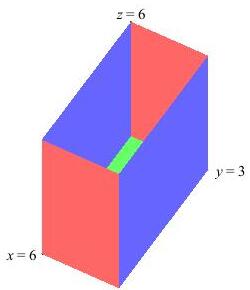
    The figure shows a box with no lid.

    Let \(x\) be the length from left to right. Let \(y\) be the width from front to back. Let \(z\) be the height. So the cost to be minimized is \[\begin{aligned} C&=\text{\textdollar}20xy+2\cdot\text{\textdollar}10yz+2\cdot\text{\textdollar}5xz \\ &=\text{\textdollar}20xy+\text{\textdollar}20yz+\text{\textdollar}10xz \end{aligned}\] The constraint is the volume \[ V=xyz=108 \] The gradients of the functions are \[\begin{aligned} \vec\nabla C&=\langle 20y+10z, 20x+20z, 20y+10x \rangle \\ \vec\nabla V&=\langle yz, xz, xy \rangle \end{aligned}\] The Lagrange equations, \(\vec\nabla C=\lambda\vec\nabla V\), are \[\begin{aligned} 20y+10z&=\lambda yz \qquad &\text{(1)} \\ 20x+20z&=\lambda xz \qquad &\text{(2)} \\ 20y+10x&=\lambda xy \qquad &\text{(3)} \end{aligned}\] The right sides become the same if we multiply (1)) by \(x\), (2) by \(y\) and (3) by \(z\): \[ \lambda xyz=20xy+10xz=20xy+20yz=20yz+10xz \] The first equality says \(10xz=20yz\) or \(x=2y\). The second equality says \(20xy=10xz\) or \(z=2y\). Plugging these into the constraint gives: \[ V=xyz=(2y)y(2y)=108 \quad \text{or} \quad y^3=27 \quad \text{or} \quad y=3\,\text{cm} \] Then \(x=z=6\,\text{cm}\). So the minimum cost is \[\begin{aligned} C&=20xy+20yz+10xz \\ &=20(6)(3)+20(3)(6)+10(6)(6) \\ &=360+360+360 =\text{\textdollar}1080 \end{aligned}\]

  7. A quartic ellipsoid is the graph of the equation: \[ \dfrac{x^4}{a^4}+\dfrac{y^4}{b^4}+\dfrac{z^4}{c^4}=1 \] where \(a\). \(b\) and \(c\) are the intercepts.
    Find the dimensions and volume of the largest rectangular solid that can fit inside the quartic ellipsoid: \[ 16x^4+81y^4+z^4=3 \]
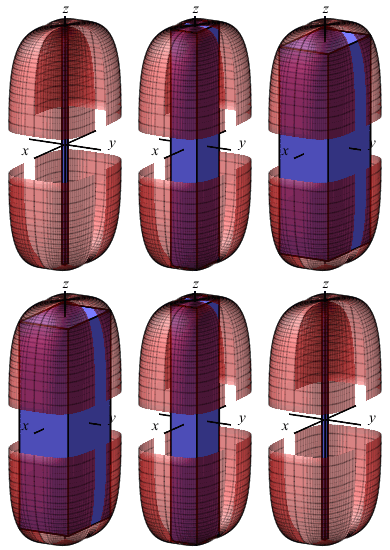
    The animation shows a recangular solid inside a quartic ellipsoid. its
      size is oscillating.

    Let \((x,y,z)\) be the corner of the box in the first octant. Then the volume is \[ V=LWH=(2x)(2y)(2z)=8xyz \] The constraint is the equation of the surface: \[ g=16x^4+81y^4+z^4=3 \] The gradients of the functions are \[\begin{aligned} \vec\nabla V&=\langle 8yz, 8xz, 8xy \rangle \\ \vec\nabla g&=\langle 64x^3, 324y^3, 4z^3 \rangle \end{aligned}\] The Lagrange equations, \(\vec\nabla V=\lambda\vec\nabla g\), are \[\begin{aligned} 8yz&=\lambda 64x^3 \qquad &\text{(1)} \\ 8xz&=\lambda 324y^3 \qquad &\text{(2)} \\ 8xy&=\lambda 4z^3 \qquad &\text{(3)} \end{aligned}\] The left sides become the same if we multiply (1) by \(x\), (2) by \(y\) and (3) by \(z\): \[ 8xyz=\lambda 64x^4=\lambda 324y^4=\lambda 4z^4 \] The three right sides give \(x\) and \(y\) in terms of \(z\): \[\begin{aligned} 64x^4&=4z^4 &\implies 16x^4&=z^4 &\implies x&=\dfrac{z}{2} \\ 324y^4&=4z^4 &\implies 81y^4&=z^4 &\implies y&=\dfrac{z}{3} \\ \end{aligned}\] Substituting this into the volume constraint gives \[ 3=16x^4+81y^4+z^4=z^4+z^4+z^4=3z^4 \] Therefore, \(z=1\), \(x=\dfrac{1}{2}\) and \( y=\dfrac{1}{3}\). So the dimensions and volume are: \[ L=2x=1, \qquad W=2y=\dfrac{1}{3}, \qquad H=2z=2, \qquad V=LWH=\dfrac{2}{3} \]

© MY Math Apps

Supported in part by NSF Grant #1123255

NSF logo