15. Polar Coordinates
b.1. Graphs of Polar Equations
The rectangular graph of an equation is the set of points whose rectangular coordinates, \((x,y)\), satisfy the equation. For example, the graphs of \(x^2+y^2=4\) and \(x^2=y^3\) are
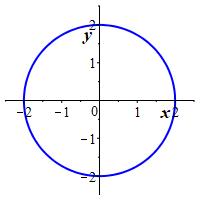
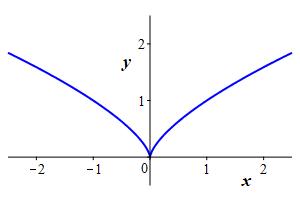
In particular, the graph of a function is the graph of the equation which defines the function. For most purposes, we take \(x\) as the independent variable and \(y\) as the dependent variable, and write \(y=f(x)\). However, sometimes we reverse the variables and write \(x=f(y)\). For example, the graphs of \(y=x^2\) and \(x=y^2\) are
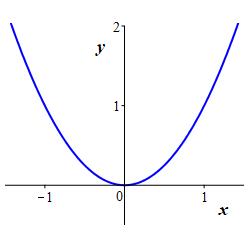
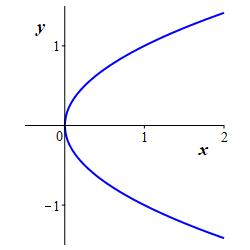
Similarly:
The polar graph of an equation is the set of points for which of polar coordinates, \((r,\theta)\), satisfy the equation. In particular, the graph of a polar function is the polar graph of the equation which defines the function. For most purposes, we take \(\theta\) as the independent variable and \(r\) as the dependent variable, and write \(r=f(\theta)\). However, sometimes we reverse the variables and write \(\theta=f(r)\).
It may seem strange, but indeed a point on a polar graph may have coordinates that do not satisfy the equation! For instance, the equation \(r=\sin^2\theta\) is satisfied by \((r,\theta)=\left(1,\dfrac{\pi}{2}\right)\) but is not satisfied by \((r,\theta)=\left(-1,-\,\dfrac{\pi}{2}\right)\) which describes the same point. We shall see that this complicates the process of finding the points of intersection of polar graphs since if two polar graphs intersect at a point \(P\), the coordinates \((r,\theta)\) of the point \(P\) that satisfy one equation may not satisfy the other.
Some polar equations have graphs that are immediately obvious, such as \(\theta=\dfrac{\pi}{6}\) or \(r=2\) or \(r=\theta\):
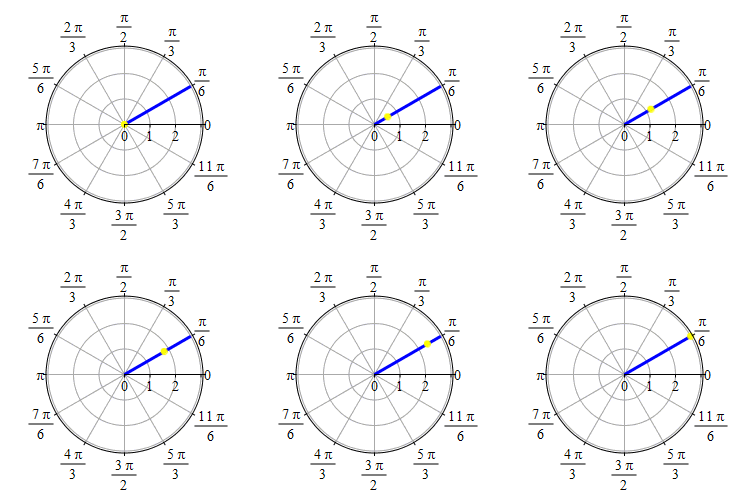
Graph \(\theta=\dfrac{\pi}{6}\).
This problem actually has two solutions. If we require \(r \ge 0\), then the graph of \(\theta=\dfrac{\pi}{6}\) is the set of points \((r,\theta)=\left(r,\dfrac{\pi}{6}\right)\) with \(r \ge 0\) which is the ray starting at the origin and going in the direction \(\theta=\dfrac{\pi}{6}\).
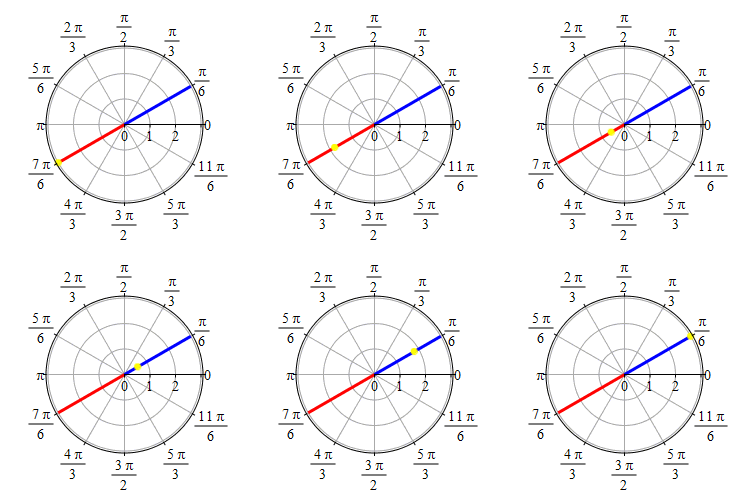
If we allow \(r\) to be negative as well as positive, then the graph of \(\theta=\dfrac{\pi}{6}\) is the set of points \((r,\theta)=\left(r,\dfrac{\pi}{6}\right)\) for all \(r\) which is the line through the origin in the direction \(\theta=\dfrac{\pi}{6}\).
So if you get a problem like this, you need to ask if \(r\) is required to be positive or not.
Graph \(r=2\).
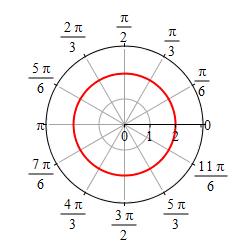
The graph of \(r=2\) is the set of points \((r,\theta)=(2,\theta)\) for all values of \(\theta\), which is the circle of radius \(2\) centered at the origin.
Graph \(r=\theta\).
We first graph the part of the curve with \(\theta \ge 0\). We start at \(r=\theta=0\) which is the origin. As \(r=\theta\) gets larger, we travel around counterclockwise and the radius also gets larger. So we trace out a spiral as shown in the first plot.
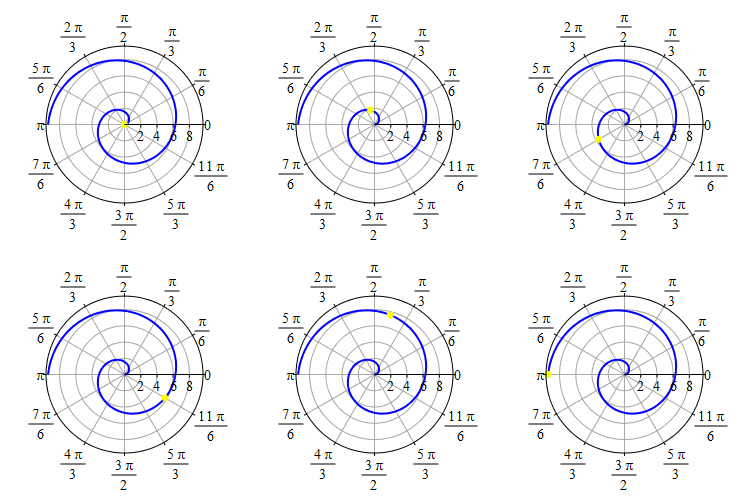
As \(r=\theta\) gets negative, we travel around clockwise and since \(r\) is also negative, we measure \(|r|\) backwards, which traces out a spiral which is the mirror image through the \(y\)-axis of the first half as shown in the second plot.
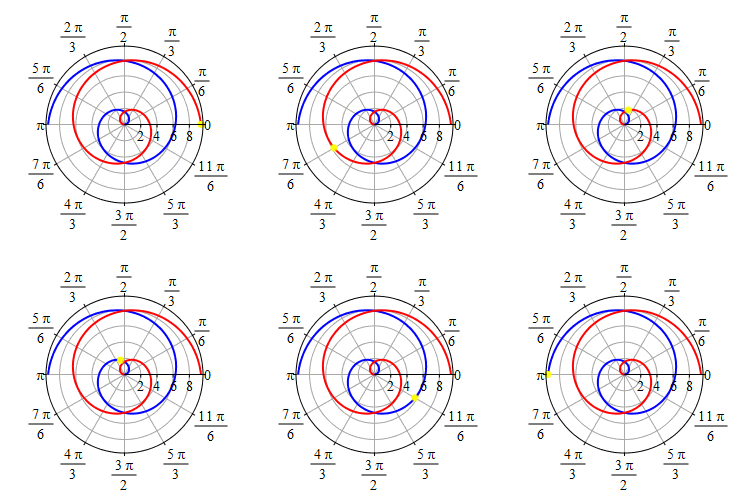
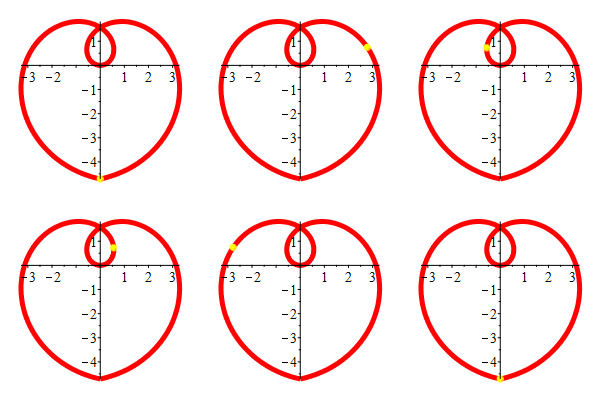
If we restrict to the part of the curve, \(r=\theta\), with
\(-\,\dfrac{3\pi}{2} \le \theta \le \dfrac{3\pi}{2}\),
we get a heart shape.
Happy Valentine's Day!
Most polar equations, however, are not so transparent! On the next page, we look at successively more complicated functions and successively more refined graphing techniques.
Heading
Placeholder text: Lorem ipsum Lorem ipsum Lorem ipsum Lorem ipsum Lorem ipsum Lorem ipsum Lorem ipsum Lorem ipsum Lorem ipsum Lorem ipsum Lorem ipsum Lorem ipsum Lorem ipsum Lorem ipsum Lorem ipsum Lorem ipsum Lorem ipsum Lorem ipsum Lorem ipsum Lorem ipsum Lorem ipsum Lorem ipsum Lorem ipsum Lorem ipsum Lorem ipsum